

For years, I have been the one telling other Latinas to go anyway. Then my friend invited me to come to Rio with her. Every article I read warned me against it. My family asked if I was sure. Even my gut was telling me not to go. The headlines stayed with me for weeks before the flight. In the end, I went anyway!! We stayed in both Copacabana and Ipanema for 10-11 days, and here’s the honest answer if you’re a Latina solo traveler trying to figure out where to stay in Rio and if it is safe enough for you.
The short answer
For a first-time solo female visitor to Rio de Janeiro, Ipanema is the safer default. The beach seems to be cleaner (or at least less crowded), the streets are quieter at night, and you can walk to Leblon and Arpoador without crossing a major road.
Copacabana is the better pick if you want more touristy energy, sometimes lower prices, and a wider range of accommodations. Both are within 20 minutes of each other on foot. Both are on Rio’s South Zone safety list. Neither will leave you bored.
I stayed in both neighborhoods during an 11-day trip in late February and early March 2026. Three nights in an Airbnb across the street from Ipanema Beach. Seven nights in a Copacabana flat three blocks from the beach near the Ipanema border.
I traveled with my friend and fellow creator, @TravelwithLadyChin. She is a Black content creator currently on sabbatical (she’s one of over 300,000 Black women who have lost jobs since the start of 2025). She speaks some Portuguese and Spanish, and this was her third visit to Rio. I’m a first-time visitor to Brazil. I speak Spanish and picked up some Portuguese on the trip. Despite being scared due to what the media says about Rio, I felt comfortable going because she had previously navigated the city twice and had some local contacts.
That matters for how you read this guide. If you’re going truly solo, without a friend like Lady Chin along for the ride, I have added a section for “Real Talk for the Solo Traveler” note inside each neighborhood section so you can adjust the recommendation to your own situation.
Disclosure: This article contains referral links to various services. If you click on these links and make a purchase, I may earn a commission or earn points or miles at no additional cost to you. These referral links help support the maintenance of this site and the creation of content. I only recommend products or services that I genuinely believe will be of value to my readers. Your support through these links is greatly appreciated.
For more information on the privacy policy, please make sure to click HERE.
Before you choose a neighborhood, my Brazil Travel Guide covers the country-level essentials: visa, currency, Pix payments, and what to know before you arrive.
Ipanema is the safer default for a first-time solo female visitor: cleaner beach, quieter at night, stronger restaurants.
Copacabana is the value pick: more energy, lower prices, more variety. Leblon is the local favorite: residential, expensive, walkable to Ipanema.
Lapa is for nightlife and Afro-Brazilian samba history (don’t sleep there your first trip).
Santa Teresa is for the cultural deep dive (worth a half-day, might be hard to base from).
My personal pick for first-timers: stay in Ipanema near Posto 9, day-trip to the rest.
Ready to book? Here are my go-to resources:
Copacabana Vs. Ipanema: the head-to-head
Most where-to-stay guides give you a generic side-by-side and let you flip a coin. Here’s what I observed walking both neighborhoods at all hours over 11 days.
Beach quality
Ipanema wins. The sand looked cleaner, the water also looks clearer, and the view of Dois Irmãos at the end of the beach is the iconic shot for a reason. Copacabana’s beach is famous and crowded. The water is fine but not as clear, and the kiosk culture along the boardwalk is louder and can be more chaotic. Both have lifeguard posts every 800 meters or so.
Walkability and feel.
Ipanema feels more residential and walkable. The streets between the beach and the lagoon (Lagoa Rodrigo de Freitas) are tree-lined and quiet. Copacabana feels more like a working neighborhood with a tourist beach attached. Buses, vendors, motorcycles, kids playing, older residents on stoops. Both are real. The right one depends on what you want to wake up to. I don’t mind noise because I am a deep sleeper but there were a few days that I was woken up by a 5:30 am bus.
Restaurants.
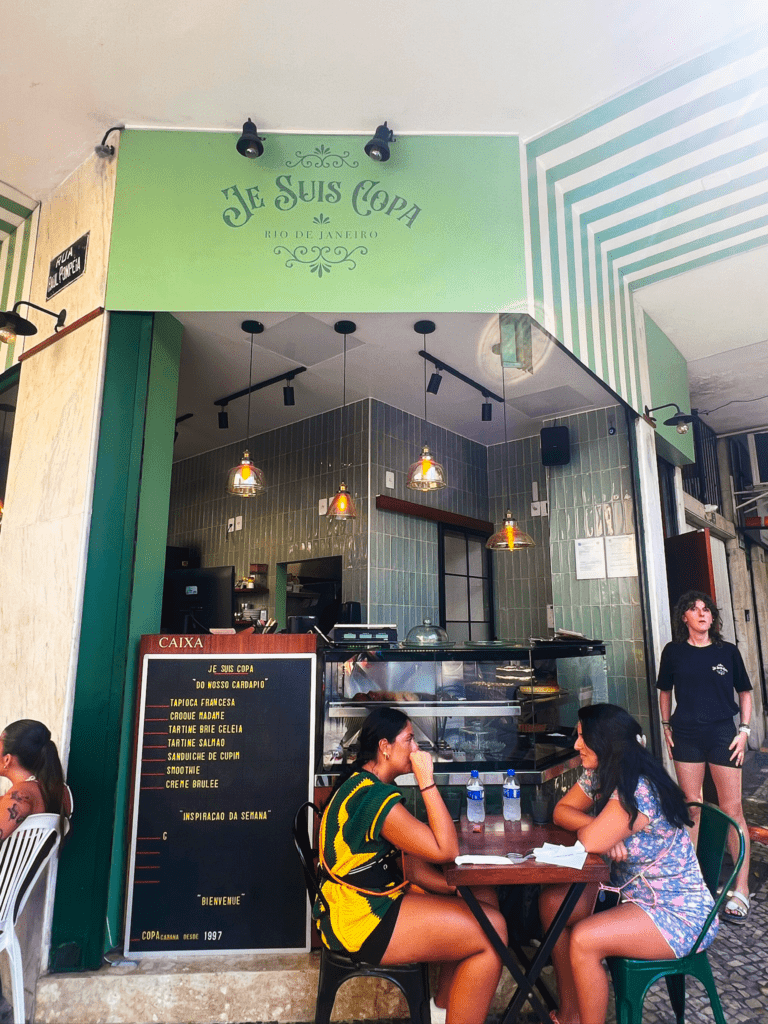
Ipanema has the better fine-dining and brunch scene. Copacabana has the better casual food and the better bakeries (padarias). I had breakfast at Sel d’Ipanema the morning after we arrived and twice at Je Suis Copa Brunch & Bistrô on Rua Raul Pompéia 109 during our Copacabana stretch. Je Suis Copa is a breakfast / brunch spot. It is located about five minutes from our second Airbnb. Cheaper than the Ipanema brunch spots, just as good (if not better).
Nightlife.
Copacabana wins on volume, Ipanema wins on quality. Copacabana has more bars per block. Ipanema has the better cocktail bars and the Posto 9 sunset crowd, which is a nightly social ritual you should experience whether you stay there or not.
Price.
Copacabana is meaningfully cheaper for similar quality. Our Ipanema Airbnb (oceanfront, 3 nights) ran roughly $356 per night, or $178 per person split. Our Copacabana Airbnb (3 blocks from the beach near the Ipanema border, 7 nights) ran roughly $172 per night, or $86 per person split. Same trip, half the cost on the Copa side. More on the math below.
Solo female friendliness.
Ipanema is the safer choice for a first-time solo female visitor at night. Copacabana’s promenade is well-policed and well-lit, but the streets a few blocks back can feel more isolated after midnight. In Ipanema, there are more people on residential streets at all hours, which is a safety asset. You should still exercise caution.
My pick if I had to choose one for a first-time solo female visitor:
Ipanema, near Posto 9. If budget is tight, Copacabana on the Ipanema side (Posto 6, near Arpoador). The Copa flat we had on the Ipanema border (Copanema) was the best of both worlds.
Browse available stays in Rio de Janeiro
Use the map below to see hotels and apartments across all of Rio’s South Zone neighborhoods. Filter by neighborhood (Ipanema, Copacabana, Leblon, etc.), check live prices, and book directly.
Where to Stay in Rio for First-Timers: Ipanema
Why I Would Stay in Ipanema Near Posto 9
Posto 9 is the social heart of Ipanema. Locals gather here every sunset. Walking distance to the Hippie Market, Arpoador rock, and Leblon.
The streets between the beach and the lagoon are tree-lined and quiet, which is what made me feel safe walking back from dinner alone.
Range: $$-$$$.
When deciding where to stay in Rio, Ipanema is usually the right call for first-timers, especially women. Ipanema sits between Copacabana and Leblon on Rio’s South Zone coastline. The neighborhood was built in the 60s and 70s with wider sidewalks, better infrastructure, and tree-lined residential streets.
The beach is divided by lifeguard posts (postos) numbered 7 through 10. Posto 9 is the social heart. Locals gather there at sunset every night. If you stay anywhere between Rua Vinícius de Moraes and Rua Garcia D’Ávila, you’ll be a 2-3 minute walk from this spot.
What I loved:
- The breakfast scene. I went to Sel d’Ipanema my first morning. Strong coffee, fresh bread, açaí done properly.
- Walking distance to the Hippie Market at Praça General Osório on Sundays. This is the famous Sunday market where local artisans sell jewelry, clothing, and art. I went on March 8, our last full day. Worth two hours.
- Easy access to Leblon (15-minute walk west) and Arpoador (10-minute walk east) for the sunset rock view.
- The lagoon (Lagoa Rodrigo de Freitas) is a 15-minute walk inland. Joggers, paddle boats, sunset views without the beach crowd.

What to know:
- Ipanema is more expensive across the board than Copacabana. Plan and budget for it.
- The metro stops are General Osório (east end) and Nossa Senhora da Paz (center). Both are within 5-10 minutes of most accommodations.
- The beach has a gay section in front of Rua Farme do Amoedo (Posto 8). Marked with rainbow flags. This is Rio’s main LGBTQ+ beach (Farme Beach) and one of the most welcoming public spaces I observed in the city.
For the Solo Traveler: Ipanema between Posto 8 and Posto 10 is the safest bet for a first-time solo female visitor. Stay within 3 blocks of the beach. Walk in the morning and afternoon, take rideshare after dark. Posto 9 sunset is a great place to start a conversation with another solo traveler if you want company. Or join in a walking tour or other group activity for an easy way to meet people.
Where to Stay in Rio for First-Timers: Copacabana
Why I Would Stay in Copacabana Near Posto 6
Posto 6 is the south end of Copacabana, walkable to Arpoador and Ipanema. This is where I stayed (but not on the beach), and it was the best of both worlds. Copa prices, proximity to Ipanema. Most blocks here are well-lit and residential, with the beach promenade five minutes away. You will also find lots of stores, restaurants and supermarkets in the area.
Range: $$ – $$$.
The other half of the “where to stay in Rio” question is Copacabana. This is where I stayed for the bulk of the trip, and where my budget math made sense.
Copacabana is the most famous beach in the world for a reason. The 4-kilometer crescent of sand from Leme at the north end to Posto 6 at the south end is one of the most photographed urban beaches on the planet. The neighborhood behind the beach is denser, older, and more working-class than Ipanema. Buildings are mostly mid-rise apartments from the 50s and 60s. The Avenida Atlântica boardwalk runs the length of the beach with the famous black-and-white wave pattern designed by Roberto Burle Marx.
What I loved:
- Je Suis Copa Brunch & Bistrô on Rua Raul Pompéia 109. We went twice in a week. A café since 2024. Delicious breakfast spot that’s now also a bistro. Affordable for US tourists, excellent coffee, and 5 minutes from our Airbnb.
- The beach kiosk culture. You can pull up a chair, order a caipirinha for under $3 USD, and stay for hours. We had one afternoon of “shopping from chair” where vendors walked the beach offering grilled cheese on a stick, handmade jewelry, sarongs, fresh fruit, and whatever else you didn’t know you wanted.
- Espeto Brasileiro for dinner after Pão de Açúcar.
What to know:
- Copacabana is louder, more touristy, and more uneven than Ipanema.
- The Posto 6 / Arpoador end is the calmest and closest to Ipanema. The Leme end (north) is quieter but more isolated.
- Three metro stations serve Copacabana: Cardeal Arcoverde, Siqueira Campos, and Cantagalo. All run reliably.
For the Solo Traveler: Stay between Posto 5 and Posto 6 (south end, near Arpoador) for the best balance of price, safety, and walkability. The promenade itself is well-patrolled at all hours. Side streets a few blocks back from the beach get quieter than they look, especially after midnight, regardless of which part of Copacabana you’re in. Do not walk by yourself late at night. When you’re getting in late, use rideshare instead of walking.
Where to Stay in Rio for First-Timers: Leblon
Why I Would Stay in Leblon
Leblon is the quietest of Rio’s South Zone beach neighborhoods.
This neighborhood features wider streets, fewer tourists, more residents, slower afternoons. If your budget supports it and you want the most peaceful solo trip, this is the pick.
Trade-off: more distance from the rest of the city.
Range: $$$$.
This is where the locals tell you to stay.
Leblon sits at the western end of the South Zone, just past Ipanema. It’s wedged between the ocean in front and Lagoa Rodrigo de Freitas behind, which gives it more open green space than any other beach neighborhood. The streets are wider. The buildings are nicer. The restaurants are some of Rio’s best. It can also be more expensive per night than Ipanema or Copacabana. Plan accordingly.
What I observed:
- I shopped at Farm Rio (at Shopping Leblon and at the original, where the brand started) and at Granado on the same afternoon. Farm Rio’s flagship store is on Rua Visconde de Pirajá in Ipanema, but they also have a Leblon presence at the Shopping Leblon mall. Granado is a 150-year-old Brazilian apothecary brand. Both are worth the visit.
- The neighborhood feels and is much more residential than Ipanema. Fewer tourists. More dog walkers. More baby strollers. More slow afternoons.
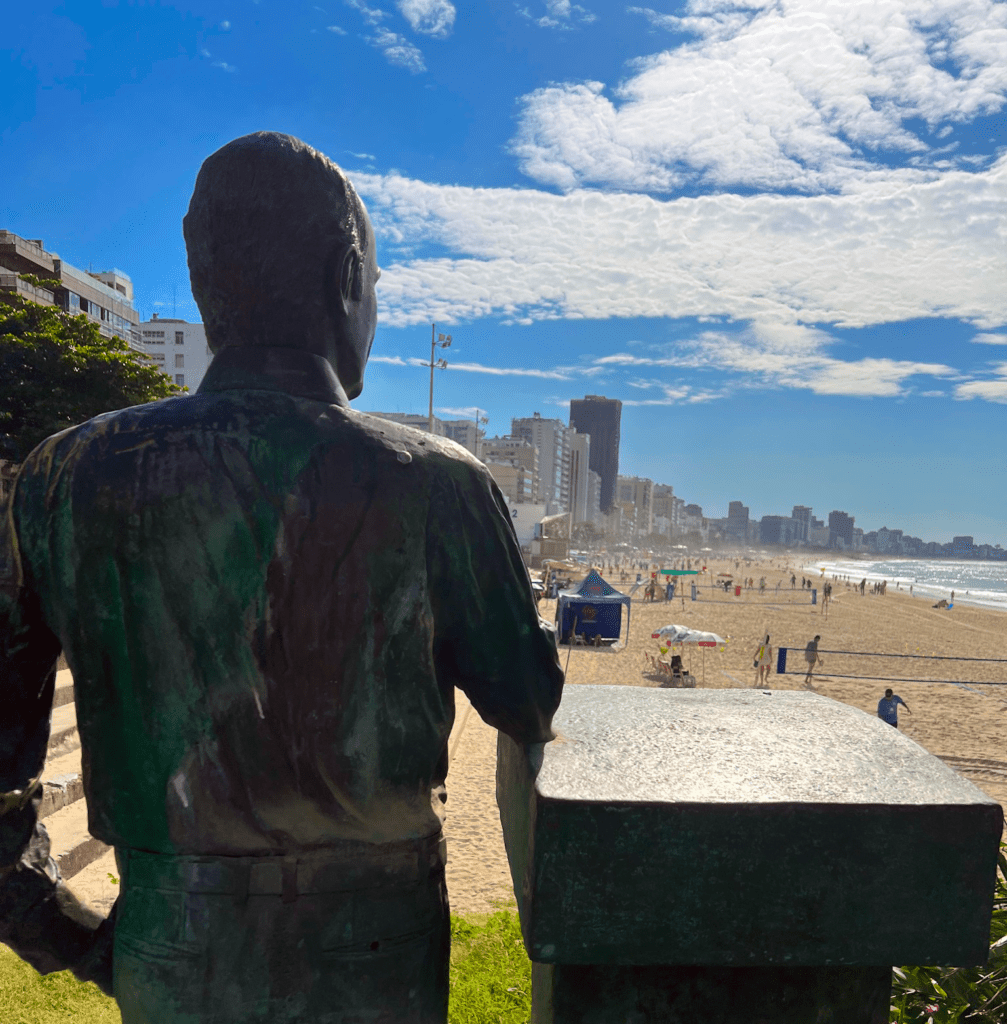
This bronze statue of Antônio Carlos Jobim stands at the edge of Leblon beach, facing east toward Ipanema. Tom Jobim co-wrote “The Girl from Ipanema,” the song most of the world associates with Rio De Janeiro. Leblon is quieter than its famous neighbor, but the statue is located here, at the beginning of the beach looking towards Ipanema.
What to know:
- Leblon is one of the most expensive neighborhoods per square meter in all of Rio. Hotel and Airbnb prices will reflect that.
- The metro doesn’t reach Leblon directly. You’ll use rideshare or the bus to get to the historic center, Lapa, or Santa Teresa. That can add up over a long trip.
- The walk from Leblon to Ipanema along the beach takes about 15 minutes. The two neighborhoods blur together at the Posto 11 / Posto 12 line.
For the Solo Traveler: If your budget supports it, Leblon is the most peaceful option for a solo female visitor. Less foot traffic at night, quieter streets, more residents and fewer drunk tourists. The trade-off is distance from the rest of the city. If you want to be in the middle of the action, this isn’t the right base.
Where to Stay in Rio for First-Timers: Lapa
Why I Would Book A Night-Life Tour Instead of Staying in Lapa
Don’t sleep in Lapa your first trip. But don’t skip it either. A guided samba and Pedra do Sal walking tour gets you the music, the history, and the safety of a local guide who knows which streets to walk and which to skip. Worth it for first-timers.
If you have a mid-high end budget, don’t sleep here on your first trip. But don’t skip the neighborhood.
Lapa is Rio’s bohemian district. It sits in the historic center, north of the South Zone beaches and close to Santa Teresa. It’s known for the Arcos da Lapa (the white aqueduct arches), Escadaria Selarón (the famous mosaic stairs), and a nightlife scene that runs heaviest on Friday and Saturday nights. It’s also one of the few neighborhoods in Rio where Afro-Brazilian samba is practiced as a living tradition, not as a tourist show.
What I observed:
- We went to Pedra do Sal on March 2 (technically in the Saúde port zone bordering Lapa). This is a foundational Afro-Brazilian samba site. It’s where samba was born in the late 1800s. On Mondays and Fridays, there’s a free outdoor party night with rotating musicians. The crowd is mostly Cariocas, and tourists.
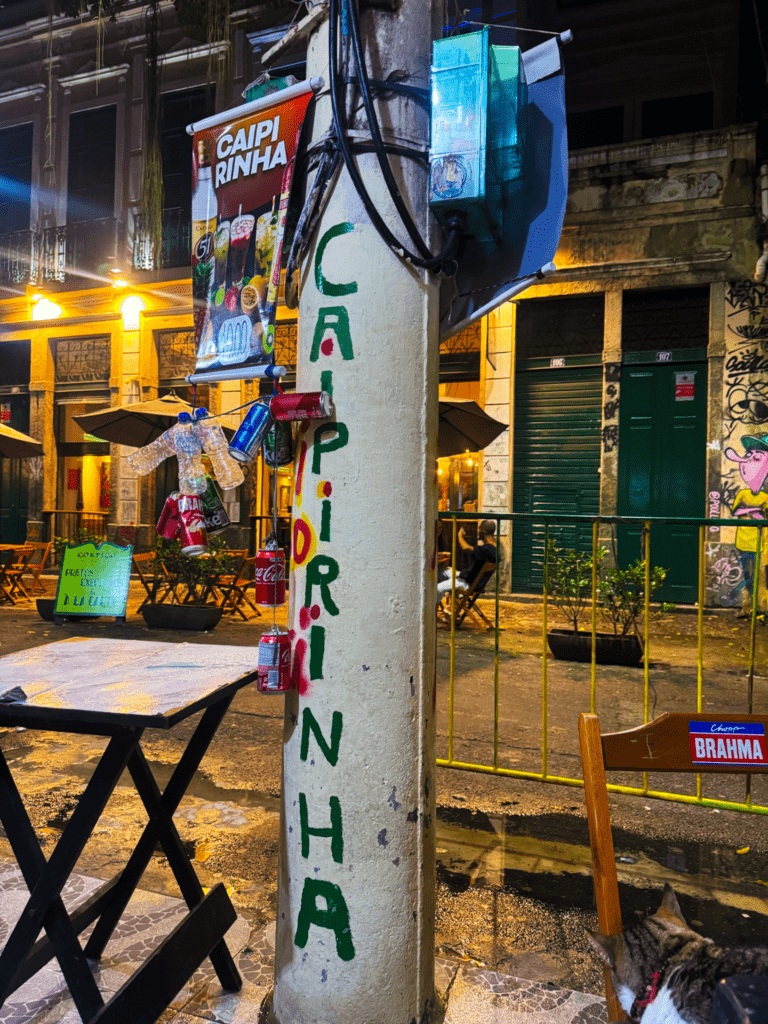
- We had a Caipifruta (or two) at Bar Da Irene on our first night. Casual, loud, cheap. The kind of place where you don’t make a reservation, you just go and enjoy drinks priced between $3- $5USD.
- In my Brazil Travel Guide, I list Ipanema, Copacabana, Leblon, Botafogo, and Flamengo as neighborhoods to stay in. Lapa isn’t on that list. It’s one of Rio’s oldest cultural districts and the nightlife around the Arcos is some of the best I’ve experienced anywhere. But it’s further from the beach, the streets get loud most nights, and if this is your first solo trip and you want a quieter home base, you’ll sleep better somewhere else. Go to Lapa for a party at night. Stay somewhere you can actually rest. Like any busy nightlife area in any major city, keep your phone in your bag and stay aware of your surroundings. Don’t accept drinks from strangers.
What to know:
- Most travel content tells solo female visitors to skip Lapa. I think that’s an oversimplification. You shouldn’t sleep in Lapa your first trip, but you should absolutely visit Lapa on a Friday or Monday night for the party of a lifetime. Just go with a plan.
- Get to Pedra do Sal or Lapa via rideshare (99 or Uber). Don’t walk in from far away. Don’t take the metro late at night.
- Stick to the main strips. Avenida Mem de Sá and the area around the Arcos are the busiest and best-lit. Side streets get sparse fast.
For the Solo Traveler: Don’t sleep in Lapa. Visit it for one night during your trip, ideally a Friday or Monday for samba at Pedra do Sal. Take a rideshare in, take a rideshare out. Don’t carry your phone in your hand. Don’t carry a bag with valuables. If you want a chaperoned introduction, GetYourGuide offers Lapa nightlife and samba walking tours with local guides that are worth the money for a first-timer.
Visiting Santa Teresa (Don’t Sleep There on Your First Trip to Rio)
Why Santa Teresa Is A Great Half or Full Day activity
For a first trip to Rio, Santa Teresa is a half-day visit, not an ideal place to sleep. A guided walking tour is the easiest way to see it without getting lost in the hills, and you’ll learn what you’re looking at instead of wandering past it. Plan to visit for a few hours, then head back to your beach base.
Santa Teresa is worth at least a half-day. Not the easiest base for a first trip.
Santa Teresa sits on a hill above Lapa and the historic center. It’s an older residential neighborhood with cobblestone streets, colonial architecture, art studios, and one of the best views of the city from the Parque das Ruínas. The famous yellow tram (Bonde) runs through it. There are guesthouses and small hotels, but where it is geographically located can make it impractical as a base for a first-time visitor that wants to constantly visit the beach.

What I observed:
- The Bonde tram (we didn’t ride it this trip) runs from Centro up into Santa Teresa over the Arcos da Lapa.
- Parque das Ruínas has one of the best free panoramic views of Rio. It’s the ruins of the home of poet Laurinda Santos Lobo, now a cultural center.
- The neighborhood feels slower than the South Zone. Residential streets, art studios, colonial architecture, no real nightlife.
What to know:
- The neighborhood is safer during the day than at night. Residential streets get sparse after dark.
- The metro doesn’t reach Santa Teresa directly.
- It’s not walking distance to the beach.
For the Solo Traveler: Don’t sleep in Santa Teresa your first trip. Stay in the South Zone where you can walk to the beach. Visit Santa Teresa for half a day, ideally with a guided walking tour so you don’t get lost in the cobblestone hills.
Would you like to save this?
How far does $100 USD actually go in Rio?
This is one of the questions that comes up most often when readers ask about Brazil. The answer in 2026, with the exchange rate around R$5.15 to $1 USD, is “further than you think, but not as far as some bloggers claim.”
Here’s the real math from my trip:
- Our Ipanema Airbnb: $1,067 for 3 nights, oceanfront, sleeps two. That’s $356 per night, or $178 per person per night. This was the splurge end of our trip, the “make the arrival feel like an event” choice.
- Our Copacabana Airbnb: $1,206.51 for 7 nights, 3 blocks from the beach near the Ipanema border, sleeps two. That’s $172 per night, or $86 per person per night. This was the practical choice that made the longer second half of the trip affordable.
- A meal at a casual local restaurant: R$25-100, or about $5-20 USD per person.
- A caipirinha at a beach kiosk: R$15, or about $3 USD.
- A metro ride: R$7.50, or about $1.50 USD.
- The Pão de Açúcar cable car: R$160, or about $31 USD per person at the time of our visit.
What this means in practice: $100 USD per day, after lodging, will cover food, drinks, transit, and one paid activity easily. With a budget Airbnb on the Copa side, you can do Rio for under $150 per day total per person. With a more comfortable Ipanema base, you’re looking at $250-300 per day per person.
If you want a hotel instead of an Airbnb, the map section shows real-time prices for available hotels in those exact areas. Compare them against the Airbnb math. Both options have a place on an itinerary.
For more on currency, payment methods (Brazil is heavily Pix-based), and what’s actually affordable, see my Brazil Travel Guide.
Safety reality for first-time solo female visitors
Brazil gets flattened by lazy travel coverage, and Rio takes the brunt of it. I arrived scared because of how the media talks about this country. 11 days later I left thinking the fear I carried was bigger than the risk that’s actually there. That doesn’t mean you should be careless. It means the real safety conversation is more nuanced than “don’t go.”
A few specifics:
The “$2,000 to enter Brazil” myth: This shows up in search data constantly, but it’s a misunderstanding of the requirements. Brazil officially reinstated the e-Visa for U.S. citizens in early 2025. The visa costs $80.90 USD and is valid for 10 years. While you must provide proof of at least $2,000 USD in available funds as part of the application process, this is not a fee you pay at the border. Full visa details are in my Brazil Travel Guide.
Practical habits we used:
The Women’s-Only Metro Car: Look for the pink cars during morning and evening rush hours for a more comfortable, “hands-off” commute.
Rideshare apps: We prioritized 99 or Uber over street taxis, utilizing the in-app safety features like “Share My Trip.” We still took a taxi here and there when Uber and 99 were not available.
Physical Security: I kept my phone on a lanyard and inside my bag while walking. Snatch-and-run thefts are the most common risk in the South Zone, and keeping the phone out of sight significantly reduces your profile as a target.
We also took these other measures:
- Offline Google Maps downloaded for the South Zone before we arrived.
- Sharing daily plans with someone back home.
- Carrying a small amount of cash and one card, not a wallet of cards.
What I’d say to a truly solo female traveler going for the first time: The neighborhoods I stayed in (Ipanema and the Ipanema-adjacent end of Copacabana) felt safe at all hours. I’d be more cautious about Copacabana’s interior streets after midnight, and I would not sleep in Lapa or Santa Teresa on my first trip. Going truly solo means erring toward the better-lit, more populated streets and using rideshare more aggressively than I did with a friend.
I’m working on a longer post specifically about solo female travel in Rio de Janeiro (coming soon) that will go deeper on this. I will publish soon and link from here.
Frequently asked questions
Resource List
👑 Subscribe to Globetrotter’s Gazette for the next post in this Rio series and exclusive content I don’t publish on the blog.
👑 Never travel internationally without travel insurance. Use this comparison tool to find a policy that fits your trip.
👑 First time considering solo travel? Read Solo Travel for Latinas: How to Conquer the World with Confidence before you book your first trip.
👑 Heading to Brazil? Start with my Brazil Travel Guide for visa, currency, language, and country-wide context.
👑 For currency conversions, use XE.
👑 Brazil e-Visa application: brazil.vfsevisa.com.

Mari is a first-gen Latina solo traveler, cancer survivor, and the founder of The Queen of Trips. She has visited 36 countries and attended 12+ travel industry conferences. Read more about her work →






 ES
ES